This article contains no affiliate links. It is an editorial piece based on ongoing conversations conducted as part of the FeedMyECS content research project. No names are used. All conversations are anonymized.
What I Found
A field report from an ongoing survey that was never supposed to be a survey
It started as outreach. It became something else.
Several months ago I began reaching out to people in my personal and professional network with a simple opening question about sleep.
The goal was straightforward — I was building out the FeedMyECS content library, focused on the endocannabinoid system and its role in sleep regulation, and I wanted to understand what real people were actually experiencing. Not what wellness brands assumed they were experiencing. Not what the research papers described in controlled populations. What real people, in real life, were dealing with when sleep didn’t work.
I expected to have maybe thirty conversations. Get a feel for the landscape. Write some articles.
100 conversations later, the project is still ongoing — and what I found is more nuanced, more human, and frankly more sobering than I anticipated.
This is my field report.
What this was — and what it wasn’t
I want to be clear about what this project is and isn’t, because I think the distinction matters.
This is not a clinical study. It has no control group, no randomization, no statistical significance in the academic sense. The people I spoke with are not a representative sample of the general population — they skew toward my personal and professional network, which means they skew toward people who already have some awareness of wellness, cannabis, or natural health.
What this is: 100 real conversations with real people about one of the most universal human experiences — the inability to sleep well — conducted over several months, documented carefully, and synthesized here as honestly as I know how.
I am not a doctor. I am a researcher, a marketer, a writer, and someone who has spent the better part of four decades paying attention to how the body regulates itself. Take this piece in that spirit.
A note on the quotes that follow. These conversations happened across DMs, comments, voice messages, and the occasional video call, over several months — so where I use quotation marks, the words are real and the person is anonymized. Where I use italics, I’ve characterized what was said: a faithful rendering of a sentiment I heard repeatedly, with the specific wording smoothed to protect privacy. The experiences are real either way. Every person behind these conversations deserves their privacy, and they have it.
The patterns
Across 100 conversations, certain themes emerged so consistently that I stopped being surprised by them and started treating them as baseline findings.
The racing mind at bedtime
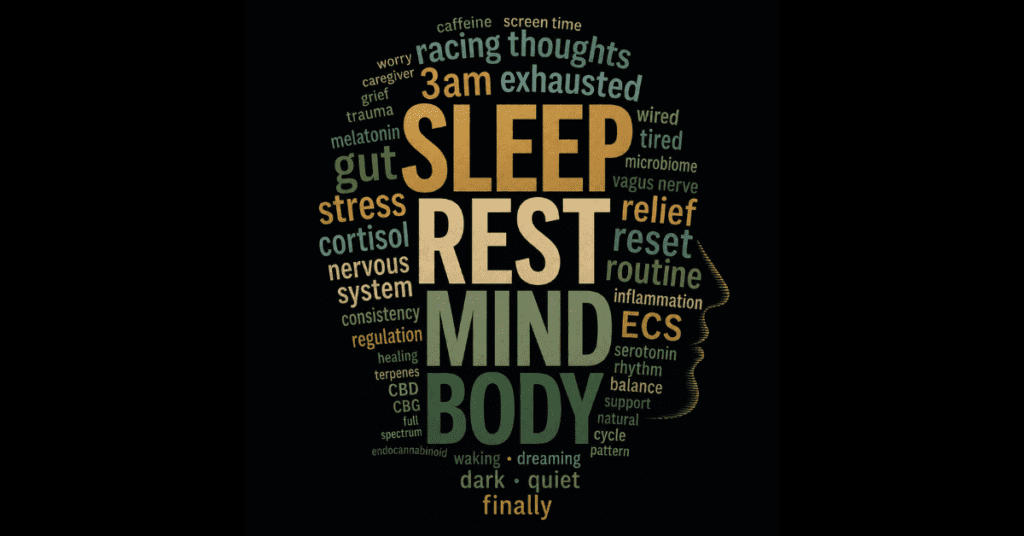
This was the single most common experience described — across age groups, genders, occupations, and health backgrounds. Almost universally, people described some version of the same thing: the body is exhausted, the conditions for sleep are present, but the brain will not stop.
The language varied. I can’t turn it off. My mind just runs. I replay the day over and over. I make lists in my head at 2am. But the underlying experience was remarkably consistent — a nervous system still in activation mode hours after the circumstances that triggered it have passed.
This is not a willpower problem. It is a nervous system regulation problem. And it is exactly the territory where the endocannabinoid system operates.
The 3am wakeup
If the racing mind at bedtime was the most common entry point, waking between 2am and 4am — and staying awake for hours — was the most common ongoing complaint.
Almost nobody knew why it happened at that specific hour. Most had assumed it was simply “how they slept” or a sign of aging or stress. Few had encountered any explanation that went beyond sleep hygiene advice — reduce screen time, keep a consistent schedule, avoid caffeine after noon.
There is a biological mechanism behind the 3am wakeup that most sleep advice completely ignores — a cortisol rebound that fires in the early morning hours as part of the body’s preparation for waking, which in people with dysregulated HPA axis function fires too early and too strongly. The ECS is directly involved in modulating this process. I’m finishing a dedicated article on exactly this — I’ll link it here when it publishes — and the early response from people who have heard me describe this mechanism has been one of the more gratifying parts of the project: “this is the first explanation that actually made sense of what I experience.”
Melatonin frustration
I did not anticipate how consistently this would come up. In conversation after conversation, people described the same arc: they started taking melatonin, it helped initially, and then over time it stopped working — requiring higher doses for diminishing returns, or producing groggy mornings, or simply ceasing to have any effect at all.
I take it and still wake up at 3. I’ve tried every brand. My doctor just said to take more. I feel like I’m dependent on it now.
Melatonin tells your body it’s dark outside. It does not tell your nervous system it’s safe to rest. Those are different signals, handled by different systems. The endocannabinoid system is involved in the latter, and it is the piece that melatonin-only approaches consistently miss.
The gut connection — a finding within the finding
Here I want to be precise, because I think the nuance matters.
The gut-brain-ECS connection is not new to me. I have been tracking this relationship for the better part of four decades, and the science connecting gut microbiome health, vagus nerve function, endocannabinoid tone, and sleep quality is well-established in the research literature.
What surprised me — genuinely — was how many people in these conversations arrived at this connection themselves, unprompted.
I would be in the middle of a conversation about sleep, and someone would offer, without any prompt from me: that when their stomach was off, their sleep was always worse. That they’d always felt these two things were connected, but no one had ever explained how. That their gut and their sleep had gone together for as long as they could remember.
That pattern, repeated across dozens of conversations with people who had no particular background in ECS science, told me something important: the lived experience is ahead of the mainstream conversation. People are sensing a connection that the wellness industry has been slow to name and explain.
That is exactly what this project exists to do.
Grief, caregiving, and the body keeping score
This was the theme that hit differently in conversation — not because I was unaware of the connection between chronic stress and sleep disruption, but because of the sheer frequency and emotional weight with which it appeared.
I should say it hit differently partly because of how familiar it was.
Caregiving is woven into the fabric of my family in a way that isn’t dramatic — it’s just how we do things. Every grandparent I knew in my lifetime died at home, cared for by family. My father’s dad. My mother’s parents. And today, her sister, who is in the late stages of dementia. We don’t send people away when they need care. That’s not a policy we ever discussed — it’s simply who we are, and my mother is the reason we know how to do it.
She has been a caregiver in some form since she was fifteen, maybe younger. Long before I was old enough to understand what I was watching, she was modeling something I would spend decades absorbing: that the people you love don’t face their hardest seasons alone, and that showing up for them — fully, consistently, across however many years it takes — is not optional.
What I also absorbed, though I didn’t have the language for it at the time, was what that kind of sustained giving costs a body. The broken sleep. The hypervigilance that follows a person home from the bedside. The inability to fully decompress even in the quiet hours, because the nervous system has learned to stay ready. The way a body holds a posture of readiness that doesn’t release just because the room is still.
So when this theme surfaced in conversation after conversation, I recognized it not from research, but from memory. And that recognition is part of why it landed as hard as it did.
Aging parents. Recent loss. Years of caregiving. Sustained high-alert states that had become the new baseline. People who had been running on empty for so long that they had forgotten what it felt like not to be exhausted.
“I lost my dad last year and it’s funny how little sleep you can live off of when something important needs to get done.”
That line, from one conversation, stayed with me. The body mobilizes extraordinary resources when necessity demands it. The cost of that mobilization — the chronic cortisol load, the depleted endocannabinoid tone, the sleep architecture that never quite recovers — accumulates quietly, and sleep is often where it surfaces first.
I heard versions of this story more times than I can count. It deserves more than a paragraph in a field report. It will get its own piece.
Trauma and the nervous system — the quietest finding
I almost didn’t include this section, because I want to handle it carefully.
Trauma and nervous system dysregulation came up in these conversations more than I expected — not dramatically, not always named as trauma, but present. People describing hypervigilance at night. People who can’t relax even when nothing is wrong. People whose sleep had never recovered from something that happened years or decades ago.
PTSD was mentioned directly by some. Others described experiences that sounded consistent with nervous system dysregulation without using clinical language.
I am not a clinician and I will not overreach here. What I will say is that the endocannabinoid system’s role in fear extinction, stress response regulation, and nervous system recovery is one of the most actively researched areas in cannabinoid science right now. It is a conversation that deserves serious, careful treatment. It will get its own dedicated piece — written with appropriate humility and appropriate rigor.
The skeptic
I want to acknowledge the people in these conversations who pushed back — who were dubious about CBD, skeptical of the ECS framing, or simply exhausted by wellness claims that had never delivered.
Their skepticism is valid. The wellness industry has overpromised on cannabinoids as aggressively as it has overpromised on everything else. “CBD cures sleep” is not a claim I make, and it is not a claim the science supports.
What the science does support — consistently, across multiple research traditions — is that the endocannabinoid system plays a documented regulatory role in sleep, stress, gut function, and nervous system balance, and that supporting it consistently as part of a broader approach produces real, if subtle, cumulative results.
The skeptics keep me honest. I’m grateful for them.
Not everyone came with a problem
Not everyone I spoke with had a sleep problem. A meaningful handful — more than a dozen across these conversations — reported sleeping well, sometimes remarkably so. One person told me, matter-of-factly, that they’d always been able to sleep anywhere. I wasn’t expecting that pattern to appear as often as it did, and I think it’s worth naming: this is not a report from a population of universal sufferers. Some people’s systems are doing exactly what they’re supposed to do. Understanding why is, if anything, as interesting as understanding what goes wrong.
What’s coming
These conversations have generated a content roadmap that will keep FeedMyECS busy for months.
Articles in development or planned:
- Why You Wake Up at 3am — the cortisol rebound mechanism, in plain English (coming soon — link to follow)
- The Terpene Conversation Nobody Is Having — why full-spectrum matters more than any number on a label
- Your Gut Has an ECS Too — And It Might Explain More Than You Think (published)
- The Caregiver’s Body — chronic stress, sleep debt, and the endocannabinoid system
- Trauma, the Nervous System, and the ECS — handled carefully, written seriously
- The Great Sleeper — what people who sleep well actually have in common
If there’s a topic you’d like to see covered — or a perspective, an experience, or a question you think is missing from this conversation — I’d genuinely like to hear it. This project is ongoing. Where it goes next is partly up to you.
This content publishes simultaneously on FeedMyECS and ECS Health Resources, a separate platform focused on research-grade ECS education for health professionals and informed consumers.
A thank you
If you were one of the people who talked to me about sleep over the past several months — in a DM, in a comment thread, over a voice message or video call — thank you.
You trusted me with something personal. The way people talk about sleep when they feel safe to be honest is remarkably vulnerable. The frustration is real. The exhaustion is real. The sense that nothing has quite worked yet is real.
This project exists because of those conversations. Every article that comes out of it is an attempt to give something useful back.
The conversation is ongoing. If you have a sleep story — or a gut story, or a stress story, or something that doesn’t fit neatly into any category — I’m still listening.
📖 feedmyecs.com
📧 jeff@feedmyecs.com
Jeff Pearson is the founder of FeedMyECS and ECS Health Resources. He holds a B.S. in Psychology and M.S. in Communication and has spent 30 years in marketing, research, and content strategy across regulated industries including cannabis and wellness. He writes from rural Cambodia, where he lives with his wife Bopha and daughter Rosa, and where the family runs a small language and technology skills school for local students and families.